U.S. Bank Routing Number
To transfer money in or out of your U.S. Bank checking or savings account, you'll need the right routing number. Find your U.S. Bank routing number below.
Routing numbers are 9-digit numbers that banks use to identify themselves. Think of them as an address that lets other banks know where to find your money.
You need your routing number for many tasks, including:
- ACH payments
- Setting up direct deposit
- Receiving benefits from the government, including tax refunds
- Transferring money between accounts at different banks or investment firms
- Automatic bill payment
- Wire transfers
Banks typically have more than one routing number if they have branches in more than one state. U.S. Bank has branches throughout the United States and uses different routing numbers for different states and regions.
Keep reading to find the right U.S. Bank routing number for your transactions.
Do U.S. Bank Routing Numbers Ever Change?
Your U.S. Bank routing number is associated with the location of the bank where you opened your account. Even if you bank at another branch, what matters is the location where you opened your account.
Here are the U.S. Bank routing numbers by state:[1]
| State | Routing Number |
|---|---|
| Arizona | 122105155 |
| Arkansas | 082000549 |
| California - Northern | 121122676 |
| California - Southern | 122235821 |
| Colorado - Aspen | 102101645 |
| Colorado - all other areas | 102000021 |
| Idaho | 123103729 |
| Illinois - Northern | 071904779 |
| Illinois - Southern | 081202759 |
| Indiana | 074900783 |
| Iowa - Council Bluffs | 104000029 |
| Iowa - all other areas | 073000545 |
| Kansas | 101000187 |
| Kentucky - Northern | 042100175 |
| Kentucky - Western | 083900363 |
| Minnesota - East Grand Forks | 091215927 |
| Minnesota - Moorhead | 091300023 |
| Minnesota - all other areas | 091000022 |
| Missouri | 081000210 |
| Missouri - Western | 101200453 |
| Montana | 092900383 |
| Nebraska (+ Council Bluffs, IA) | 104000029 |
| Nevada | 121201694 |
| New Mexico | 107002312 |
| North Carolina | 064103707 |
| North Dakota (+ Moorhead, MN) | 091300023 |
| Ohio - Cleveland | 041202582 |
| Ohio - all other areas | 042000013 |
| Oregon | 123000220 |
| South Dakota | 091408501 |
| Tennessee | 064000059 |
| Utah | 124302150 |
| Washington | 125000105 |
| Wisconsin | 075000022 |
| Wyoming | 307070115 |
| All other states | 091000022 |
If you don't see your area or state listed or are unsure where you opened your account, read on for other ways to find your routing number.
The first four digits pertain to the Federal Reserve. The next four are unique to your bank, basically the bank's address for the Federal Reserve. The final digit is a mathematical calculation of the first eight digits—it's used to prevent fraud.
Routing Numbers for Domestic/International Wire Transfers
Wire transfers are a faster way to send money than an ACH transfer. From your U.S. Bank account, you can wire money to other bank accounts, and other accounts can wire funds to you.
Receiving Domestic/International Wire Transfers
Use the routing number associated with your account's U.S. Bank branch location from the list above.
U.S. Bank
800 Nicollet Mall
Minneapolis, MN 55402
Sending Domestic Wire Transfers
Visit a branch location and bring a valid ID. You'll need your routing and account numbers, plus:
- Recipient's name as it appears on the account
- Location of the recipient's bank (including city and state)
- Account number
- Bank routing number
- Incoming (Domestic): $20.00
- Outgoing (Domestic): $30.00
- Incoming (International): $25.00
- Outgoing (International): $50.00
Sending International Wire Transfers
Visit a branch location and bring a valid ID. Use the U.S. Bank SWIFT code USBKUS44IMT.
SWIFT codes are the international equivalents of the U.S. routing numbers. They direct the money to the correct bank for international transfers.
You'll also need:
- Recipient's name as it appears on the account
- Recipient bank name, address, and country
- Recipient account number (you may need a country-specific account structure, e.g., a CLABE for Mexico or an IBAN for international bank accounts)
- Recipient bank's SWIFT code
- Currency of recipient's account (foreign currency or U.S. dollars)
- Purpose of wire
Which U.S. Bank Routing Number Should You Use?
For any domestic money transfer activity:
Use the routing number for the branch where you opened your account.
For domestic wire transfers:
Use the routing number for the branch where you opened your account.
For international wire transfers:
Use the U.S. Bank SWIFT code USBKUS44IMT.
Other Ways to Find Your U.S. Bank Routing Number
 |
| © CreditDonkey |
Here are several other ways to find your U.S. Bank routing number:
Use a Check
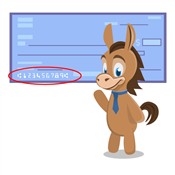
For checking accounts, you can find the routing number on the bottom of checks corresponding to your checking account. It's the 9 digits located at the bottom left of the check.
Go Online
Log onto the U.S. Bank website. Then select the applicable account. In the top box, you'll find your account number and routing number.
Call Customer Service
Call U.S. Bank at 800-872-2657. After you provide a few specific details to identify yourself, a representative will be able to confirm your account's routing number.
Although your debit card is associated with a bank account, you do not use a routing number for debit card transactions. Routing numbers are only used for transfers directly between bank accounts.
Likewise, credit cards do not have routing numbers since they are not directly linked to any bank account. When you pay your credit card online, you may need to use your bank account routing number to set up the link between your credit card account and checking account, like you would for any other bill.
Other Ways to Transfer Money with U.S. Bank
Nowadays, you can transfer money without having to leave home. Here are other ways to transfer money with U.S. Bank.
Zelle
To send money with Zelle, all you need is an email address or a phone number. There's no need for the recipient's account number, and you can send money domestically within minutes. Just click the built-in Zelle icon in the app, and then send money.
Online Transfers
Another option you have is transferring directly from your U.S. Bank account. You can transfer internally, to your accounts, other U.S. Bank accounts, or externally to other banks.
- Online Banking: Log in and go to Pay Bills & Transfer > Transfer Money.
- App: Log in and go to Transfers > Transfer money.
Wire Transfers
If you need to send larger amounts of money domestically, you can utilize U.S. Bank's send wire transfer feature on the app or through online banking. [4]
- Online Banking: Log in and go to Transfer, deposit & Pay > External transfers & wires > Send wire.
- App: Log in and go to Pay bills & transfer > External transfers, wires, & ACH > Wire money.
In most cases, bank-to-bank wire transfers are delivered within 24 hours.
Bottom Line
You'll likely need your U.S. Bank routing number when managing your finances. Keep it handy should you need to set up a direct deposit, automatic payment, or wire transfer.
References
- ^ U.S. Bank. Routing Numbers, Retrieved 03/26/2024
- ^ U.S. Bank. How do I receive a wire transfer?, Retrieved 03/26/2024
- ^ U.S. Bank. How much does a wire transfer cost?, Retrieved 03/26/2024
- ^ U.S. Bank. How do I send a wire transfer?, Retrieved 03/26/2024

Chase Total Checking® - $400 Bonus
- New Chase checking customers can receive $400 when you open a Chase Total Checking® account and make direct deposits totaling $1,000 or more within 90 days of coupon enrollment.
- Unlock more offers with Chase. Get up to $500 per calendar year by referring friends and family. Plus, get cash back from top brands with Chase Offers when you use your debit card.
- Chase Total Checking® has a $15 monthly service fee, you can easily avoid the fee with direct deposits totaling $500 or more, or a minimum average daily balance each statement period.
- Chase Overdraft Assist℠ – no overdraft fees if you're overdrawn by $50 or less at the end of the business day or if you're overdrawn by more than $50 and bring your account balance to overdrawn by $50 or less at the end of the next business day*

- Chase Mobile® app makes banking simple. Manage accounts, pay bills, send money to friends with Zelle® and deposit checks on the go with Chase Quick Deposit℠.
- Chase has the largest branch network in the U.S. with thousands of ATMs and branches. Use the Chase locator tool to find a branch or ATM near you.
- Chase helps keep your money protected with features like Zero Liability Protection, fraud monitoring and card lock.
- Chase Total Checking includes FDIC insurance up to the maximum amount allowed by law.

Bank of America Advantage Plus Banking® - Up to $500 Bonus Offer
- New checking customers only: Get a bonus offer up to $500 after completing qualifying transactions. See offer page for more details
- Bank of America N.A. Member FDIC.

CIT Bank Platinum Savings - 4.10% APY Boost
| Tier | Boost APY |
|---|---|
| Balance over $5,000 | 4.10%* |
| Balance less than $5,000 | 0.60%* |
After boost is completed, you will continue to earn our best standard rates:
| Tier | APY |
|---|---|
| Balance over $5,000 | 3.75%1 |
| Balance less than $5,000 | 0.25%1 |
- Needs to use promo code to qualify: CITBoost
- Boost lasts 6 months over standard APY
- Tiered account
- $100 minimum account opening
- Member FDIC
- No Monthly Service fees
- No account opening fees

HSBC Premier - Up to $5,000
- Get $1,500: Deposit or invest $150,000 to $249,999
- Get $2,500: Deposit or invest $250,000 to $499,999
- Get $3,500: Deposit or invest $500,000 to $999,999
- Get $5,000: Deposit or invest $1,000,000+
How the offer works
- Open a Premier checking account by August 31, 2026
- Add your preferred amount of deposits and/or eligible investments within 20 days
- Maintain your balances for 3 full consecutive months
- Remain opted-in to receive HSBC marketing emails
If all offer requirements are met, the bonus will be paid within 8 weeks.
Discover what Premier gives you access to
- Premier Relationship Savings: Earn our best savings rate with a Premier Relationship Savings account for an introductory period and thereafter if you qualify.
- HSBC Global Money Transfers: Send money internationally, securely, quickly and fee-free in the mobile app, with our award-winning5 HSBC Global Money Transfers
- Credit cards: Enjoy a competitive range of rewards and benefits that complement your lifestyle
- Wealth management: Get a personalized financial plan, global opportunities and a Wealth Relationship Manager for investment support via HSBC Securities (USA) Inc.

No-Fee Business Checking
- $0 monthly service fee
- $0 minimum opening deposit
- Open up to 20 individual business checking accounts
- Earn up to 3.00% APY with automated savings
- Issue up to 50 Visa® debit cards to your team
Write to Andres S at feedback@creditdonkey.com. Follow us on Twitter and Facebook for our latest posts.
Note: This website is made possible through financial relationships with some of the products and services mentioned on this site. We may receive compensation if you shop through links in our content. You do not have to use our links, but you help support CreditDonkey if you do.
|
|
| ||||||
|
|
|




Compare: